












Nonconformance refers to any situation where a product, process, or outcome does not meet established standards or requirements. In manufacturing and operations, it can appear in many forms from minor quality deviations to process inconsistencies that affect overall performance. Understanding this concept is an important step in maintaining structured and reliable operations.
When nonconformance is managed properly, businesses can improve product quality, reduce rework, and maintain stronger control over operational costs. Clear documentation, consistent monitoring, and cross-team coordination help organizations respond more effectively while supporting continuous improvement efforts.
However, gaps in process control and reporting can make nonconformance harder to track and address consistently. Taking a closer look at how nonconformance is handled in daily operations can reveal practical ways to strengthen quality management and overall business performance.
Key Takeaways
|
What Is Nonconformance?
Nonconformance, also known as non-conformity, is formally defined as a failure to meet a specified requirement. These requirements can originate from a wide array of sources, including a company’s internal quality standards and government regulations.
In a business context, nonconformance occurs whenever a product, service, or process deviates from its intended standard. This concept extends far beyond just defective products; it covers a broad spectrum of issues, such as incorrect documentation,
While the terms nonconformance and defect are often used interchangeably, they possess a crucial distinction. A defect is a specific type of nonconformance where the product fails to meet its intended use or functional requirements, potentially rendering it unsafe or unusable.
In contrast, a nonconformance might not affect the primary function of a product at all. For instance, a mislabeled package or a slight color variation on a finished good are nonconformances, but they are not necessarily defects.
Therefore, while all defects are nonconformances, not all nonconformances are defects. Understanding this difference is vital because it dictates the appropriate disposition and corrective actions, which can range from a minor rework to a full-scale product recall.
Why Is Managing Nonconformance Crucial For Business?
Effective nonconformance management is not merely an administrative checkbox or a peripheral task for the quality department; it is a strategic pillar that underpins the overall health and sustainable growth of any business.
Ignoring these deviations is akin to tolerating small leaks in a ship; individually they may seem minor, but collectively they can lead to significant financial loss, reputational damage, and a stifling of innovation.
Conversely, organizations that proactively manage nonconformance are able to transform each issue into valuable data, creating a powerful feedback loop for improvement. This proactive stance allows to resolve existing problems.
By implementing a robust nonconformance management system, a company can unlock substantial benefits across its entire operation. From achieving financial efficiency to fostering unwavering customer loyalty, every facet of the business is positively impacted.
This commitment is an investment that not only shields the organization from operational and regulatory risks but also paves the way for achieving operational excellence and a more potent competitive edge in the marketplace.
Here are the primary reasons why every business leader should prioritize a structured approach to managing nonconformance.
Pressing unnecessary operational costs
Every instance of nonconformance introduces high hidden costs that can accumulate rapidly. These expenses manifest in various forms, including the cost of rework to fix faulty products and the financial burden of handling warranty claims from dissatisfied customers.
By systematically identifying the root causes of nonconformances and implementing preventive measures, companies can dramatically reduce this waste. According to a report by the American Society for Quality (ASQ), the cost of poor quality can represent 15-20% of sales revenue on average.
Improving customer satisfaction and loyalty
In today’s market, customers demand consistency and high quality from the products and services they purchase. Any nonconformance, no matter how small, can disrupt the customer experience and tarnish the brand’s image.
A solid nonconformance management system ensures that only products meeting the highest quality standards reach the customer. This consistency builds trust, enhances satisfaction, and ultimately cultivates a loyal customer base that is less likely to be swayed by competitors.
Maintaining compliance with industry standards and regulations
In many industries, such as manufacturing, pharmaceuticals, and construction, adherence to standards like ISO 9001 and government regulations is mandatory. A nonconformance can lead to failed audits and even severe legal repercussions.
A well-documented nonconformance management system serves as tangible proof that a company is operating in compliance with required standards. This not only mitigates legal and financial risks but also simplifies maintaining crucial certifications.
Driving a culture of continuous improvement
Each Non-Conformance Report (NCR) is a repository of invaluable data. It doesn’t just highlight what went wrong; it compels the team to investigate why it happened. This process of root cause analysis provides deep insights into weaknesses within existing systems.
By analyzing trends in nonconformance data, management can make informed, data-driven decisions to implement systematic process improvements. This fosters a proactive culture of continuous improvement, creating a virtuous cycle.
Common Types of Nonconformance
To manage nonconformances effectively, an organization must classify them correctly. This classification helps determine the level of urgency, potential risk impact, and the appropriate corrective actions required.
Not all nonconformances carry the same weight; some may require only a minor adjustment, while others could pose a serious safety risk to end users or threaten the viability of the business.
Generally, nonconformances can be categorized by severity or by their point of origin within the business process. This dual approach provides a clear framework for quality and operational teams to conduct an initial assessment.
A strong understanding of these categories also facilitates clearer communication between departments, ensuring that all stakeholders share a common perspective on the gravity and nature of each incident as it arises. Common types of nonconformance, such as major nonc
Major Nonconformance
A major nonconformance is a significant deviation that could lead to the failure of a product’s primary function, pose a safety risk to the user, or result in substantial financial loss for the company.
This type of nonconformance often violates a critical regulation or a mandatory industry standard. Examples include the use of substandard materials in a building’s structural components or a malfunction in a vehicle’s braking system.
The discovery of a major nonconformance demands immediate action, such as a production halt and complete product segregation, followed by an in-depth investigation to prevent recurrence.
Minor Nonconformance
A minor nonconformance is a deviation that does not affect the core function or safety of a product but still represents a departure from the established specifications. Its impact is often cosmetic, administrative, or may cause only a slight inconvenience to the user.
Examples include minor scratches on a product’s surface, a typographical error in a user manual, or a slight color variation from the approved standard. Although their individual impact is less severe, an accumulation of minor nonconformances can erode the brand’s perceived quality.
Categorization by Source (Product, Process, System)
In addition to severity, classifying nonconformances by their source is a powerful tool for streamlining root cause analysis. A product nonconformance is an issue found in the final product itself, such as incorrect dimensions or a missing component.
A process nonconformance occurs when a standard procedure or workflow is not followed, like a machine operator skipping a required inspection step. Finally, a system nonconformance represents a failure at the quality management system level, such as an internal audit procedure.
The Standard Nonconformance Management Process (NCR Process)
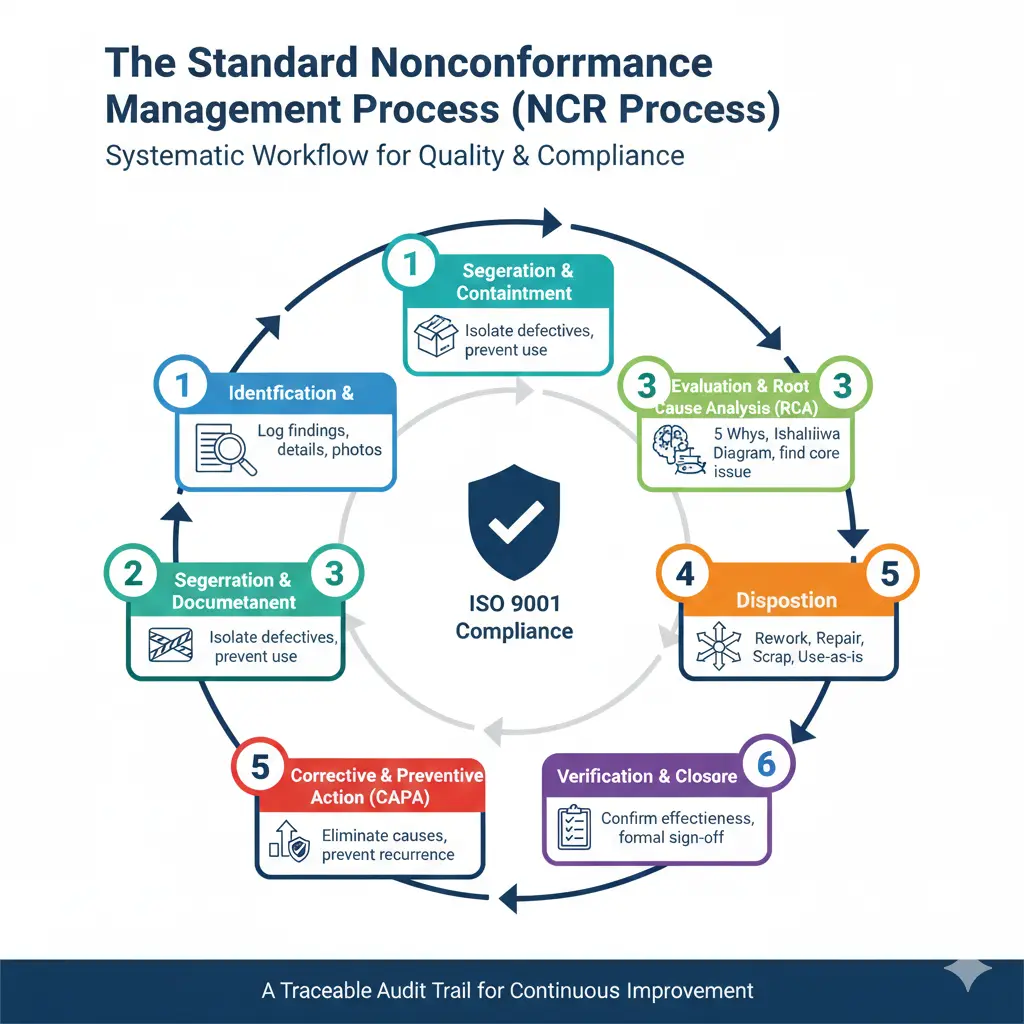
Effective nonconformance management relies on a structured and systematic workflow, commonly known as the Non-Conformance Report (NCR) process. This process serves as a definitive roadmap for an organization to handle every deviation consistently.
Without a standardized process, problem-solving tends to be reactive, inconsistent, and often fails to address the underlying root cause, leading to the recurrence of the same issues over time.
The primary goal of the NCR process is to ensure that every incident is thoroughly documented, its impact is contained, its root cause is identified, and appropriate actions are taken to prevent it from happening again.
This workflow creates a clear and traceable audit trail, which is essential for compliance with quality standards like ISO 9001 and for conducting internal performance analysis. The following are the key stages of a standard nonconformance management process adopted by leading organizations worldwide.
1. Identification and Documentation
The process begins the moment an employee, auditor, or customer identifies a potential nonconformance. This finding must be immediately documented in a Non-Conformance Report (NCR).
This report should capture critical details, including a clear description of the problem, where it was found, the date and time of discovery, the specific product or process affected, and any supporting evidence such as photographs or measurement data.
2. Segregation and Containment
Once a nonconformance is identified and documented, the immediate next step is to segregate the affected products or materials. This action prevents them from being mixed with conforming products or inadvertently shipped to a customer.
These items are typically marked with highly visible labels (e.g., “Hold” or “Quarantine”) and moved to a designated, secure area. This containment step is designed to limit the scope of the problem and provide the quality team.
3. Evaluation and Root Cause Analysis
A designated team, often a cross-functional group including representatives from quality, production, and engineering, then evaluates the nonconformance. Their primary objective is to conduct a Root Cause Analysis (RCA) to determine the fundamental reason for the failure.
Methodologies such as the 5 Whys or an Ishikawa (Fishbone) Diagram are frequently employed at this stage to look beyond the immediate symptoms of the problem. The goal is to uncover the foundational issue so that the corrective actions implemented will be truly effective.
4. Disposition
Based on the findings of the evaluation, the team must decide on the disposition of the nonconforming product. There are several standard disposition options. Rework involves bringing the product back into compliance with its specifications.
Repair makes the product acceptable for its intended use, though it may not fully meet all specifications. Scrap means the product is discarded because it cannot be fixed. Use-as-is allows the product to be accepted with a concession, typically requiring approval from senior management.
5. Corrective and Preventive Action (CAPA)
This is arguably the most strategic stage of the NCR process. Based on the root cause analysis, the team formulates a Corrective Action to eliminate the cause of a detected nonconformance.
More importantly, they also develop a Preventive Action to eliminate the cause of a potential nonconformance to prevent its occurrence. These actions might involve redesigning a product, implementing new quality checks, or providing additional employee training.
6. Verification and Closure
After the corrective and preventive actions have been implemented, the process is not yet complete. The team must verify the effectiveness of the actions taken to ensure they have successfully resolved the issue and will prevent it from recurring.
This verification can be accomplished through follow-up audits, additional inspections, or by monitoring performance data over a defined period. Only after the actions have been proven effective can the Non-Conformance Report (NCR) be formally closed, completing the cycle.
The Role of Technology in Optimizing Nonconformance Management
In today’s fast-paced digital economy, relying on paper forms and spreadsheets to manage nonconformances is an outdated and inefficient approach fraught with risk. Manual processes are highly susceptible to human error, including lost data and delayed reporting.
This lack of real-time visibility and fragmented data prevents management from seeing the bigger picture, analyzing trends, and making the swift, informed decisions needed to maintain a competitive edge.
This is precisely why the adoption of technology, particularly an integrated system, is key to transforming nonconformance management from a reactive chore into a proactive, strategic function.
The utilization of modern software, such as an Enterprise Resource Planning (ERP) system, is revolutionizing how companies handle deviations from quality standards. Technology enables every stage of the NCR process, from initial reporting to final analysis, to be automated, transparent, and centralized.
This not only dramatically improves operational efficiency but also turns raw nonconformance data into actionable business intelligence. With the right digital tools, companies can build a connected and highly responsive quality ecosystem.
Data centralization and real-time reporting
A modern ERP system provides a single, centralized platform where all Non-Conformance Reports (NCRs) can be created, stored, and accessed by authorized personnel from any location.
This centralized data repository eliminates the chronic problems of lost documents or out-of-sync versions that plague manual systems. Managers can utilize real-time dashboards to monitor key metrics such as the number of open NCRs.
Workflow automation and notifications
Technology empowers the automation of the entire nonconformance management workflow. When an NCR is initiated, the system can automatically route it to the next responsible person in the process, for instance, from a shop-floor operator to a quality supervisor.
Automated notifications for pending tasks or approaching deadlines ensure that no step is overlooked and that the process moves forward according to the established timeline. This automation significantly reduces the cycle time required to resolve issues.
Integration with other modules in an ERP system
The greatest strength of leveraging an ERP system lies in its inherent ability to integrate seamlessly with other critical business modules. For example, a nonconformance identified in a batch of raw materials can automatically trigger a hold on that stock in the inventory management system.
This level of integration ensures end-to-end visibility and coordinated action across departments, which is especially critical in complex industries like semiconductor manufacturing, where the quality of every single component is paramount.
Data analytics for predictive action
With all nonconformance data consolidated within a single system, companies can leverage advanced analytics tools to identify patterns and trends that would be invisible in manual reports.
For example, data analysis might reveal that a majority of nonconformances occur on a particular machine, during a specific shift, or when using materials from a certain supplier. According to a study by McKinsey, data analytics can help manufacturers reduce the total cost of quality by up to 20 percent.
This insight allows management to shift from reactive corrective actions to proactive, predictive measures, such as scheduling preventive maintenance for the problematic machine or re-evaluating the supplier’s quality standards.
Examples of Nonconformance Management in Various Industries
While the principles of nonconformance management are universal, their application varies significantly across industries, each with its own products, processes, and regulatory landscape.
Examining practical examples from diverse sectors provides business leaders with a clearer understanding of how these principles are implemented in real-world scenarios. Every industry faces its own specific challenges, and resolve nonconformances reflects its unique priorities
From the high-precision environment of an automotive assembly line to the dynamic and rugged conditions of a construction site, nonconformance management plays a vital role in ensuring quality, safety, and efficiency.
The following examples illustrate how the structured NCR process is applied to address distinct problems, showcasing the flexibility and importance of this systematic approach. These real-world applications make it clear that nonconformance management is a strategic tool for any business committed to excellence.
Manufacturing Industry
At an automotive assembly plant, a quality inspector on the line discovers that the bolts used to attach a door panel are not being tightened to the required torque specification. The operator immediately creates an NCR using a terminal at their workstation.
The system automatically places a hold on all vehicles that have passed that station since the last successful check and sends an instant notification to the production supervisor and quality engineer.
A subsequent investigation reveals that the automated torque tool was out of calibration. The corrective action involves recalibrating the tool immediately, and a preventive action is implemented to increase the frequency of calibration checks from weekly to daily.
Construction Industry
During a routine inspection on a high-rise building project, the project manager finds that the concrete used for a structural column has failed its compressive strength test, falling below the standard specified in the engineering documents.
An NCR is issued immediately, and all work in that specific area is halted. The project team, in collaboration with the structural engineering consultant, conducts an evaluation to assess the impact of the nonconformance on the building’s structural integrity.
The disposition is to demolish the non-compliant column and recast it with concrete that meets the standard. As a preventive measure, procedures for on-site material testing are tightened for all future concrete pours.
Food and Beverage Industry
A dairy processing plant’s automated temperature monitoring system detects that a storage tank containing pasteurized milk has exceeded its safe temperature limit for 30 minutes.
The system automatically triggers an alarm and generates an NCR. The entire batch of milk within that tank is immediately segregated and labeled “Do Not Use.” The investigation quickly identifies a faulty valve in the cooling system as the root cause.
The disposition is to dispose of the entire batch to eliminate any risk of bacterial contamination. The corrective action involves replacing the faulty valve, while a preventive action adds valve performance checks to the daily maintenance schedule.
Study Case: Reducing Nonconformance in a Manufacturing Plant
A mid-sized manufacturing facility experienced recurring quality deviations in its production line, resulting in frequent rework, increased material waste, and missed delivery deadlines. Although the team had standard operating procedures (SOPs), inconsistent documentation and delayed reporting made it difficult to identify the root causes of nonconformance. As a result, the company faced rising operational costs and customer dissatisfaction.
To address this, the plant implemented a structured nonconformance management approach that included real-time reporting, standardized defect categorization, and corrective action tracking. Shop floor teams were empowered to log issues immediately using digital forms, while managers monitored trends through consolidated dashboards. This enabled faster identification of problem areas and more accurate tracking of corrective actions.
Within months, the company saw a measurable drop in repeated defects and rework rates. Teams were able to resolve issues earlier, prevent recurrence, and allocate resources more effectively. By turning nonconformance data into actionable insights, the plant improved product quality, reduced unnecessary costs, and strengthened internal accountability—highlighting the value of a disciplined, proactive approach to quality management.
Conclusion
Managing nonconformance is a core discipline that supports operational stability and long-term business growth. When deviations are treated as learning opportunities, organizations can continuously refine processes and strengthen overall performance.
A structured NCR process—from identification to verification—helps ensure that issues are not only corrected but also understood at their root. This makes corrective and preventive actions more effective, reducing repeat problems and reinforcing system reliability over time.
In today’s environment, digital tools make it easier to track cases, connect departments, and gain clearer visibility into quality performance. To better understand how this approach could support your operational priorities, consider discussing your needs through a consultation to explore the most suitable direction.
Frequently Asked Questions
-
What is the first step to building a nonconformance management system?
The first step is to establish a clear, standardized procedure for identifying and documenting nonconformances. This involves creating a user-friendly Non-Conformance Report (NCR) form and training all employees on when and how to use it.
-
How often should management review nonconformance data?
Nonconformance data should be reviewed regularly, typically on a monthly basis in management review meetings. This allows for the timely identification of trends and the implementation of strategic improvements before minor issues become major problems.
-
Do small businesses also need to manage nonconformance?
Absolutely. While their systems may be simpler, small businesses benefit greatly from managing nonconformance to reduce waste, improve product quality, and build a strong reputation. It is a fundamental practice for any business committed to growth.
-
What is the main difference between corrective and preventive action?
A corrective action is reactive; it aims to eliminate the root cause of a nonconformance that has already occurred. A preventive action is proactive; it aims to eliminate the root cause of a potential nonconformance to prevent it from happening in the first place.